The Anatomy of a Disciplined Portfolio: What an 8% Mindset Actually Looks Like
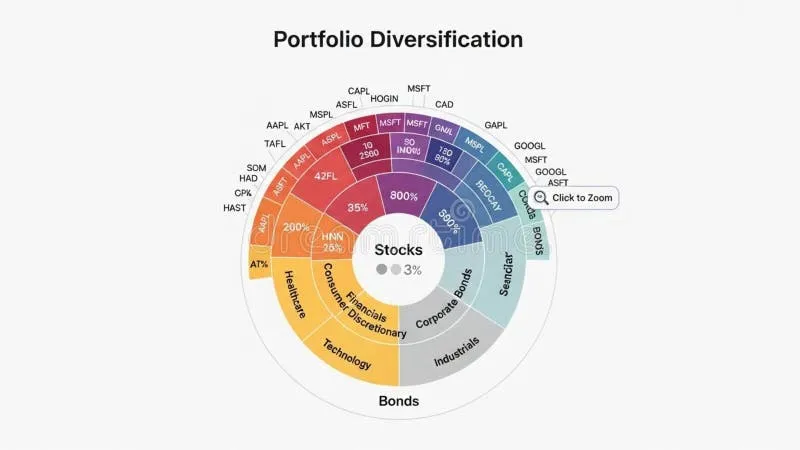
Photo: diversified investment portfolio allocation charts on desk, via thumbs.dreamstime.com
At MBI8 Capital, the number in our name is not decoration. It refers to a conviction we hold and publish without apology: for most American households, a long-run total return of roughly 8% per year — before inflation — is both achievable and sufficient. Chasing 30% is how portfolios die quietly. Earning 8% repeatedly, with low fees and low drama, is how they compound into something meaningful.
This article is a structural walkthrough of what that mindset looks like in practice, using a hypothetical $50,000 portfolio.
The Target Return Is a Constraint, Not a Ceiling
The first thing an 8% discipline changes is your search behavior. If your goal is 8% total return over a full market cycle, you do not need concentrated bets on unprofitable small caps, leveraged ETFs, or whatever momentum trade is dominating financial television this week. You need broad equity exposure, a measured allocation to bonds and cash, and the patience to let variance work itself out.
Historically, a diversified US equity allocation has delivered long-run annualized total returns in the neighborhood of 7–10%, depending on the period measured. An 8% target sits inside that band. The discipline is not in the number; it is in refusing to abandon the plan when a year delivers 3% or a quarter delivers negative 12%.
A Hypothetical $50,000 Walk-Through
Consider a US investor, age 40, with $50,000 in a taxable brokerage account and retirement funds held separately. An 8%-mindset allocation might look like this:
- $30,000 — Broad US equity index exposure (60%): a total-market fund holding thousands of companies, not a curated list of fifty tickers.
- $7,500 — International developed and emerging markets (15%): diversification against a single-country valuation cycle.
- $10,000 — Investment-grade bonds and Treasuries (20%): the shock absorber that funds rebalancing during equity drawdowns.
- $2,500 — Cash and short-term T-bills (5%): liquidity for emergencies so the equity sleeve is never sold at a bad moment.
The expected blended return of this mix, under ordinary assumptions, lands in the high single digits over a full cycle. There is no secret ingredient. The returns come from the market itself, harvested at minimal cost.
Rebalancing: A Calendar, Not an Impulse
Here is where most self-directed portfolios leak returns. Rebalancing should be scheduled — annually, or when any asset class drifts more than five percentage points from target — and executed mechanically. Suppose equities rally and the $30,000 sleeve grows to $36,000 while bonds lag. The disciplined move is to sell $3,000–$4,000 of equity and buy bonds, restoring the original weights. That action forces you to trim winners and add to laggards, which is the entire mechanism by which rebalancing adds value.
What an 8% portfolio does not do is rebalance in response to headlines. A Fed announcement, a tariff dispute, an earnings season — none of these are rebalancing triggers. The calendar is the trigger.
Fees: The Silent Line Item
Run the arithmetic. A portfolio costing 0.05% annually in fund expense ratios versus one costing 1.25% through high-fee funds and a paid advisory wrapper differs by roughly $600 per year on a $50,000 balance — before compounding. Over twenty-five years, that spread, compounded at 8%, exceeds $70,000 in foregone wealth. Fee control is not a footnote to strategy; it is strategy.
The same logic applies to trading costs and tax drag. An 8%-mindset investor uses tax-advantaged accounts first, holds taxable equity positions long enough to qualify for long-term capital gains treatment, and avoids short-term trading that converts ordinary income into a larger tax bill.
What This Philosophy Rejects
The 8% discipline has a negative space — a list of things it refuses to do. It rejects leveraged products designed to amplify daily index moves. It rejects subscription services promising triple-digit win rates. It rejects the emotional whiplash of checking a portfolio daily when the plan is calibrated over decades.
None of this is glamorous, and that is precisely the point. The compounding article we published earlier made the mathematical case; this one makes the operational one. Between the two lies the whole thesis of this publication: markets are not a puzzle to be cracked by the clever, but a system to be accessed patiently by the disciplined.
An 8% return, repeated without interruption, doubles a portfolio roughly every nine years. The investor who understands that does not need to decode anything. They need to stay seated.